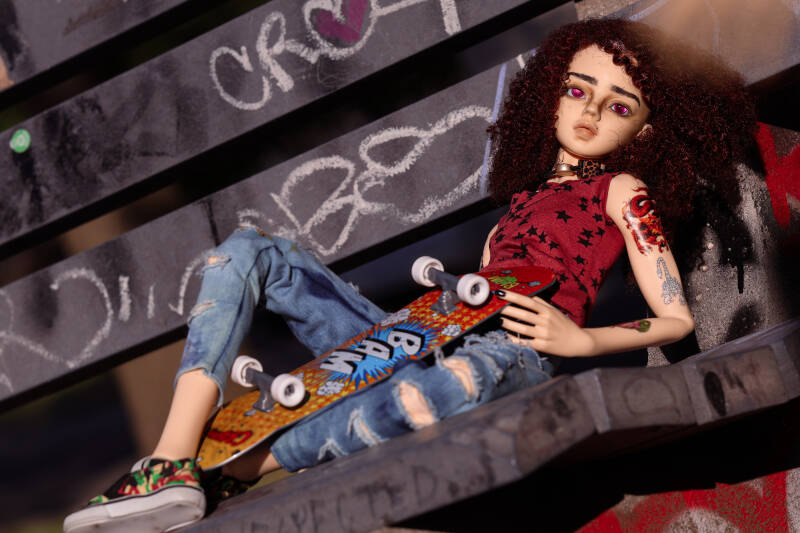
For years, watermarking photographs was almost standard practice online. If you spent hours setting up a doll, perfecting their pose, arranging a backdrop, getting the lighting right, taking the photograph and editing it, putting your name somewhere on the finished image made sense. It told people, this is my work.
But in 2026, I find myself wondering: do watermarks actually protect our doll photography anymore?
Why We Started Watermarking in the First Place
Watermarks didn't appear for no reason.
Doll photography has been shared across forums, blogs, Tumblr, Pinterest, Instagram and countless other websites over the years. Once an image was saved and reposted, it could quickly become separated from the photographer who originally created it. A watermark gave that photograph an identity.
Even if someone found your picture somewhere completely different, there was a chance they could read the username or website on it and eventually find their way back to you.There was also the hope that a watermark would discourage people from stealing photographs and claiming them as their own. And to some extent, it probably did.
But the internet has changed considerably.
A Watermark Isn't Really Protection Anymore
Even before the recent explosion of AI tools, a determined person could remove a watermark using Photoshop. Cropping, cloning and content-aware editing have existed for years. Generative AI has simply made that process easier.
Modern editing tools can analyze the surrounding photograph and attempt to reconstruct whatever was underneath an unwanted object or piece of text. That means a watermark that might have once required some Photoshop knowledge to remove can potentially be erased with considerably less effort.
So if someone is genuinely determined to steal your photograph, a watermark isn't going to make your image theft-proof. That doesn't mean watermarks are completely useless. They can still discourage casual misuse, and they can provide attribution when an image is saved and shared. But I think it's important to recognize what they actually are in 2026. They're primarily an attribution tool and a deterrent, not a security system.
What Does the Watermark Cost the Photograph?
This is where my personal feelings about watermarking come in. Doll photography can be incredibly artistic. Some photographers build entire miniature environments. Others photograph outdoors, create elaborate lighting setups, tell stories through posing or spend hours editing an image to achieve a particular atmosphere.
When you've put that much thought into a photograph, adding a large watermark can become another visual element in the composition. And sometimes that element doesn't belong there.
Your eye might naturally move from the doll's face to their hands, then toward something in the background and suddenly you're looking at a username stretched across the bottom of the image. For photographers who approach doll photography as artwork rather than simply documentation, I think that's a real trade-off.
You're permanently changing the experience of the photograph for everyone who legitimately wants to enjoy it in an attempt to discourage the relatively small number of people who might misuse it. For me personally, that trade-off isn't worth it.
Not Every Repost Is the Same
I also think the doll community could sometimes use a little more nuance when discussing stolen or reposted photographs.
There is a huge difference between someone seeing a beautiful doll photograph, saving it and casually sharing it because they love it and someone deliberately pretending that they created the photograph.
Neither situation necessarily has to be something the photographer is comfortable with. Artists are completely entitled to ask people not to repost their work. But intent and impact still matter.
Someone using your photographs to sell a doll they don't own is serious. Someone using your work commercially without permission is serious. Someone creating an account pretending to be you or claiming your photography as their own is serious.
Those situations can justify reporting accounts, requesting removal or taking whatever reasonable steps are available through the platform. Someone sharing a photograph because they thought your doll was beautiful isn't necessarily operating with the same intentions.
Personally, I don't think every instance of an image appearing somewhere else on the internet needs to become a crisis.
There Is Still a Good Argument for Watermarking
Despite all of this, there is one reason I think watermarks continue to make sense. Attribution. Maybe the goal isn't to prevent someone from stealing the photograph.
Maybe it's simply making sure that when your photograph inevitably travels outside your own account, your name travels with it. Someone might save an image from Instagram, send it to a friend, post it on Pinterest and eventually have it reposted somewhere completely different. Metadata disappears. Captions disappear. Tags disappear.
A small username embedded into the photograph might survive. For photographers who regularly have their work reposted, that alone might make watermarking worthwhile. And ultimately, every photographer gets to decide where that balance falls.
The Internet Has Changed
I think some of our attitudes toward protecting photographs are still based on an older version of the internet. We now live in a world where screenshots happen constantly, images travel between platforms within seconds and increasingly powerful editing tools are available to ordinary users.
Once we upload something publicly, we unfortunately lose a certain amount of control over where that image might eventually appear. That doesn't mean we surrender ownership of our work. It doesn't mean people suddenly have permission to impersonate us, profit from our photographs or claim our artwork as their own.
It simply means that trying to make an image impossible to take may no longer be realistic. For me, I'd rather let the photograph exist exactly as I intended it. If someone genuinely misuses my work, there are reporting systems and other options available to deal with that situation when it happens.
Other photographers will understandably make a different choice, especially if they've experienced repeated image theft or impersonation. Neither approach has to become a universal rule for the hobby. Because ultimately, I think the question in 2026 isn't really: “Will a watermark stop someone from taking my photograph?” It probably won't.
The better question might be: “Is having my name permanently attached to this image worth changing how the photograph looks?” For some photographers, absolutely. For me? I'd rather keep the photograph.
Add comment
Comments