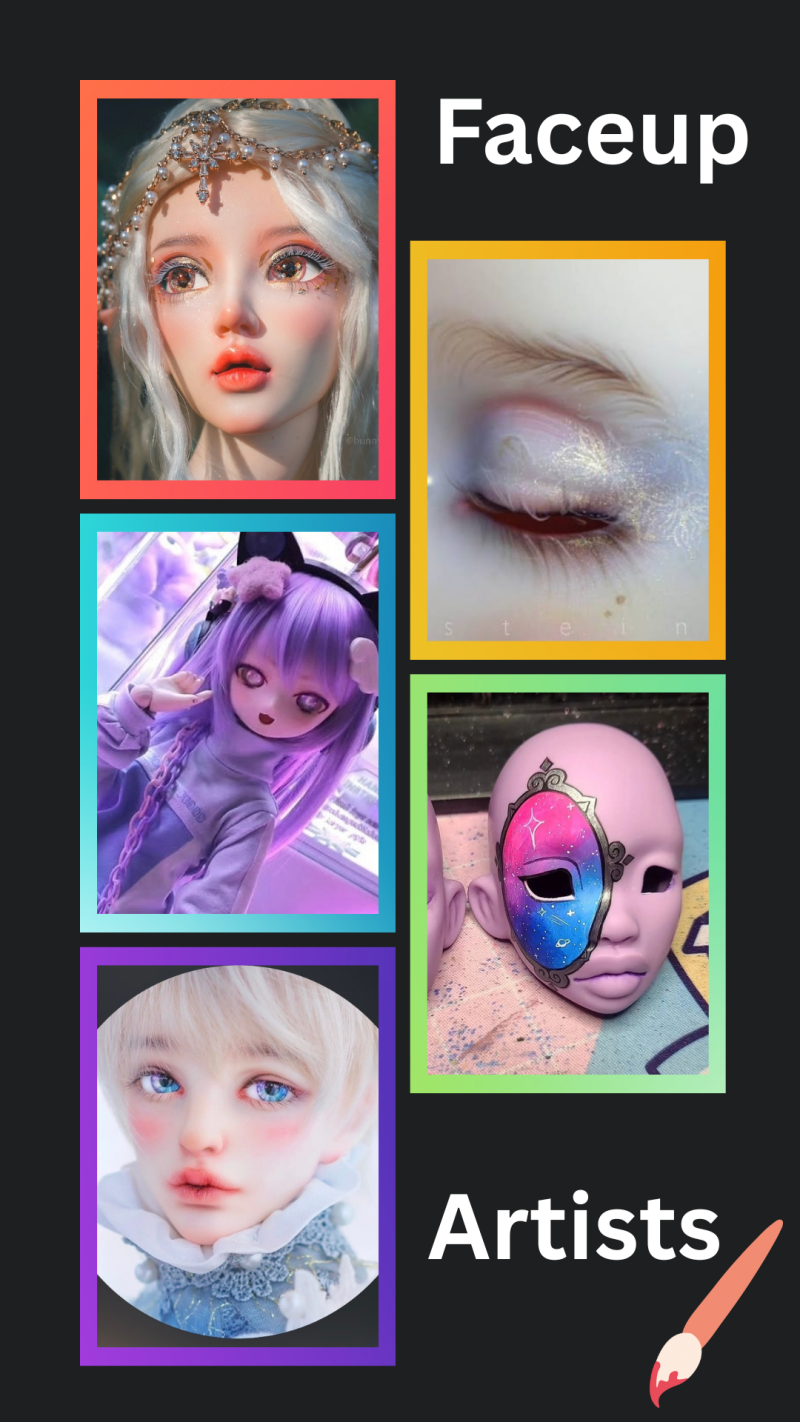
Behind every beautiful ball-jointed doll is an artist who brings it to life. Faceup artists transform blank resin into expressive characters through painting, creativity, and countless hours of practice. In this special Resin Circle feature, I interviewed several talented BJD faceup artists to give collectors an insider's look into their world. From how they got started to their creative process, favorite projects, and advice for newcomers, these interviews celebrate the skill and passion that make this part of the hobby so unique.A huge thank you to Canadian artist@Bunny_faceup (Bunny), Canadian artist @Gweneveryn (Gwen), Canadian artist @6anli, European artist @Mssteinart (Ms.Stein)and Canadian artist @Sugarylump (Sarah) who generously shared their experiences with the Resin Circle community.
Every faceup artist has a story. Whether they discovered the hobby through a single doll, a love of painting, or years of artistic exploration, each journey is unique. To begin, I asked each artist to share what first inspired them to become a BJD faceup artist and how long they've been practicing their craft.
Bunny: I began collecting BJDs in 2012, and I still vividly remember seeing my first doll a Fairyland Chicline Ineffa. I was captivated by how delicate and meticulous the faceup was. My initial motivation actually came from a place of preservation; I felt it would be a tragedy if such beauty eventually faded and I had no way to restore it.I started as a self-taught amateur, scouring the limited information available at the time just to learn how to do touch-ups. Naturally, that curiosity evolved into a desire to master the craft. I have now been a faceup artist for 13 years. While it began as a side hobby, three years ago I made the pivot to dedicate myself to this art and business full-time. In many ways, I feel the BJD world chose me rather than the other way around.
Gwen: I first wanted to become a faceup artist as I wanted to find out how to make my own cute dolls! When I first joined the hobby, auction heads from YJA (yahoo japan auctions) were very popular and expensive, so I decided it would be easier to do it myself. I've now been doing faceups for 5 years!
Ms.Stein: I actually started painting once I got my first doll. At first I didn’t really think about becoming a faceup artist, until one day I was approached by someone who then asked if they could commission me to paint their doll. That was in early 2012, and this first commission gave me the confidence to open my services locally. Later, in 2019 I decided to expand my services and offer commissions internationally and I'm still going to this day. It was also during this time that I really began investing in my studio, with a specific focus on delivering faceups of the best quality. I decided that I needed to pay particular attention to developing my skills, in order to reach a level I could be satisfied with.
I guess it was just a natural series of developments that led to this becoming my profession and it brings me so much joy!
6anli: I got into the BJD hobby because I wanted to customize dolls myself, so I started offering this service to others once I felt my skills were mature enough. I’ve been doing it since 2019!
Sarah: I started doing face ups in February 2017. YouTube suggested Dollightful's tutorial to me, I was in the car buying the tools and dolls 2 hours later! I think I've made over 1000 custom dolls now!
Every artist has their own workflow, and the time it takes to complete a faceup can vary depending on the style and level of detail. I asked a few of the artists to share how long a typical faceup takes from start to finish and what factors influence their process.
6anli: The process for a single face-up takes around three days of work. However, there is also a lot of preparation involved, such as cleaning the head and spraying sealant, as well as finishing steps like applying gloss and lashes, which require time outside of the drawing process and make the overall timeline longer. Moreover, each stage of the process is typically repeated for a batch of heads (6–8 for me) before moving on to the next stage. In other words, I work on multiple heads at once to save time while waiting for materials to dry, which further extends the time needed to complete one head.
Sarah: A bjd face up usually takes me 2-3 hours depending on complexity. That doesn't count drying and spraying time, which breaks it up a lot and spreads one face up over several days. I'm very fussy about the conditions when I use sealant, I wait out bad weather so that I know it'll cure properly. I'd cry real tears if my customer told me the face chipped off with light wear!
Finding the right faceup artist is about more than choosing a style you like it's also about finding someone whose communication, process, and artistic vision align with your own. I asked Gwen to share her advice on what collectors should consider when selecting the right faceup artist for their doll.
Gwen: Good question! Collectors should look at multiple works from an artist and choose based on the faceup style they like best. Many artists specialize in a certain style, so my advice is to choose an artist that works mainly in the style that you want to achieve for the doll!
Pricing a custom faceup involves much more than the finished result. Materials, experience, time, and the complexity of the design all play a role in determining the final cost. I asked Bunny to share how she approaches pricing her faceups and what collectors should keep in mind when commissioning an artist.
Bunny: Pricing art is a common struggle, and my process has evolved alongside my craft. Since I started as an amateur, my rates have increased gradually to reflect my improving technical skills and the shifting economy. My philosophy is to find a balance: the price must be fair for my labor and expertise, but I also strive to keep it accessible. This hobby is incredibly healing, and I want to help as many collectors as possible experience the joy of seeing their "beloved" dolls come to life.
A well-cared-for faceup can remain beautiful for many years, but its longevity depends on factors such as handling, storage, and environmental conditions. I asked Ms. Stein to share how long a faceup typically lasts and what collectors can do to help preserve their doll's appearance.
Ms.Stein: The lifespan of a faceup can vary, depending on a few factors, the most important of which is the type of sealant used and if it was applied correctly. Naturally, the second is attention and being careful while handling the head. Generally my faceups can last for years. If handled with sufficient care then easily 10 years or more, unless the owner either has a new idea or just wants to add some additional touches. As a matter of fact, I recently had a commission from a customer with a head that I had worked on ten years prior. It was truly a wonderful thing to receive this head again and see my old work.
Every faceup presents its own unique challenges, and even experienced artists continue to encounter techniques that require patience and precision. I asked a few artists to share what they find to be the most difficult part of creating a faceup and how they overcome those challenges.
6anli: I would say just like with everything else, the begining is the hardest. Pulling something out of thin air is always a tough process. The first soft pastel layer lays the foundation to everything else, such as the shape of the brows, the lips, the overall vibe of the faceup. Therefore, there is also of thoughts put into the first layer. For this reason, it is also the most time taking step!
Sarah: The most difficult part of face ups is symmetry! It will forever be the bane of my existence. I find looking at my work upsidedown and/or through my phone's camera helps to see problem areas better.
Every faceup artist develops a unique artistic voice, but each new doll also brings its own personality and creative possibilities. I asked Sarah how she balances her signature style with the individual character of each doll she paints.
Sarah: For my own work that is completely artist's choice, I wing it every single time. I find that's most fun for me. I'm always trying new things, I hate to be stuck in one look. For the longest time, I think the way I did eyebrows made me stand out, but not in a great way. I've learned a lot from bjd face ups, it's softened my line work a lot!
For a customer's doll, I will bend over backwards to give them whatever they want. It can be a bit disheartening when they basically want a factory generic face up - those are actually the hardest to replicate and they have little to no uniqueness, which is boring for me.
Even the most carefully painted faceup can be affected by how it is handled and cared for over time. I asked a few faceup artists to share some of the most common mistakes collectors make and their advice for keeping a faceup looking its best for years to come.
Ms.Stein: Generally, if you are careful, and don’t keep touching the face of your doll, or soak it in water, you should be able to enjoy your faceup for a very long time. I definitely think if there is a need to touch the faceup it's much safer to wear gloves. I would also advise to store the dolls somewhere away from sunlight and in a steady, dry environment. Not only for the sake of keeping the resin in good condition, but also because faceups can lose their vibrant colours when exposed to direct sunlight for too long.
If the faceup gets dusty or dirty, I recommend using a simple fluffy, dry brush to remove any dust from the faceup. For more stubborn blemishes, you can use a kneaded eraser or a dry magic sponge. However, you should still be very gentle and careful with a magic sponge, so as not to damage the layers or sand them away completely.
It’s worth to mention that when travelling with your doll, a plastic face shield is a must!
6anli: 4. Honestly, I can't really think of anything maintenance wise! Commission wise, I would suggest refraining from using more comprehensive words like 'moody' or 'bright' etc. Just do your best to discribe the features how you would like them to look!
Behind every commissioned faceup is far more than paint and supplies. Artists invest countless hours into developing their skills, purchasing quality materials, communicating with clients, and carefully bringing each doll to life. The time, care, and emotional energy involved can also contribute to creative burnout, something many artists experience but collectors may not always see. I asked a few artists to share what goes into the cost of a faceup that collectors might not realize.
Gwen: I do my best to provide a mockup that both the client and I are happy with! So I don't get burnt out on the work easily, as they say, work that you love is hardly work
Bunny: While my financial fees are transparent, there are "invisible" factors in the creative process that are vital to the final result.
The Technical Constraints: Sealants are notoriously temperamental and can be quite dramatic depending on the environment. I often have to build extra time into my schedule just to ensure the sealant has cured perfectly. In "rough months" with high humidity or temperature shifts, I won't rush the process; I would rather wait for the perfect conditions than risk a client's doll facing unexpected issues later.
The Creative Energy: People often see the finished product, but they don't see the "artist’s block." Painting a faceup is a deeply focused task, and sometimes the creative flow gets stuck. It takes mental discipline to navigate those moments to ensure the final character is perfect.
Saving Cost from Clients: To reach my current level of technique, I navigated years of frustration, disappointment, and failed attempts. Ultimately, my mastery serves as a shield for my clients. By applying my expertise, I save them the frustration, time, and financial risk of an unsuccessful faceup. My goal is to provide a seamless experience so that they can immediately enjoy their 'dream' doll and focus on the happiness and healing this hobby provides.
Ms.Stein: To be honest, there’s a lot of stuff that goes into the cost but it’s not always physical.Obviously, having a professional studio or even setting one up is the most costly thing,but there’s also ongoing costs like petrol, bubble wrap, CoAs, business cards and even paying a higher electricity bill to keep a painting studio in the ideal condition for painting.Buying the relevant professional equipment isn’t cheap either. Not many people realise how much artist grade pastels or paints can cost. I would also mention that even software, like Adobe, is necessary if you want to deliver professional quality photographs. You have to be able to show your product in the best light possible. It’s certainly a lesser known, but significant expense. There are also taxes that needs to be paid, or simply the cost of living, just as any other self-employed individual. Not to mention the non-physical cost, such as issues with mental health and burnout. Unfortunately, as with every other job, a work-life balance is very important to maintain the quality of service and satisfaction on both sides. For me, the BJD hobby ceased to be just a hobby a long time ago, and I wouldn’t have it any other way.
A finished faceup is only one part of an artist's work. Behind every commission are hours of planning, communication, practice, and creative decision-making that often go unseen. I asked a few artists what they wish more collectors understood about their work and the realities of being a faceup artist.
Ms.Stein: Being a faceup artist is not just about sitting and painting dolls. It's also managing the whole business behind the scenes. It requires not only a lot of testing new materials, stocking them, research, finding new solutions, developing your style and linework, but also marketing, listing, photography, social media, responding to customers and maintaining a relationship with them and keeping on top of the painting queue (which can sometimes get quite long). Everything takes time and time doesn't flow the same way for a collector as it does for an artist. When I work, time seems to fly much faster, whereas collectors usually just have to wait for their faceup/ready product ect. For me, as a faceup artist, it's day after day of work and various tasks to finish and get to their place in the queue.Patience is really important.I would also ask you to trust your faceup artist with the suggestions or solutions they offer, because we know if a particular wish or element will or won't work with your head.
Gwen: There are many challenges that come with being basically a freelance artist, one of which is overhead costs, securing materials, and time spent on a project. Many times, even securing studio space and time to seal heads can be difficult. Some materials can also be impossible to secure as they are restricted from being shipped or prohibited from entering Canada. Being a niche hobby, it can also be difficult to improve your skills after a certain point as there is a lack of resources. And since most of everyone is self taught, there is no one around to crituque your work and point out areas of improvement. So while we work very hard, we also invite you to help us improve wherever possible.
Where an artist is based can shape their experience in unexpected ways. From shipping costs and material availability to reaching international collectors and navigating different markets, location can influence both the opportunities and challenges of running a faceup business. To conclude this feature, I asked all of the artists how being based in their respective countries has affected their visibility, pricing, and access to opportunities as faceup artists.
Sarah: With recent political events and changes in the US, being Canadian is suddenly a disadvantage purely because of mailing. The vast majority of the BJD and doll market in North America is in the US, prominently California and New York State. Making it harder and more expensive to mail between our countries has been catastrophic for my small business, essentially killing it, because pre 2025 90% of my business came from the US. That has been a very tough pill to swallow.I don't think I have less opportunity for visibility than others. I think that's why social media can be so brilliant, it puts everyone on the same stage regardless of location, give or take a few countries overseas.I do price lower than my peers, but I still consider myself a newer bjd face up artist. I also charge Canadians less than everywhere else because I take so much pride and pleasure from working on dolls for my fellow Canadians. I have recieved an outpouring of
love and support from Canadian buyers.
During this crazy time we live in, and that means the absolute world to me. No country is perfect, we certainly have our problems, but I am proud to be Canadian. I think we try to do the right thing more often than not, and there's a consideration for your fellow human that I've seen absent in other places I've lived.
6anli: From what I've experienced so far, customs fees are the only thing my customers and I do get frustrated about. Fingers crossed the parcel won't be charged.
Bunny: While being in Canada can present certain geographic challenges, I’ve actually found ways to turn my location into a strategic advantage. From a pricing perspective, the current exchange rate allows me to offer high-end, professional services that remain very competitive and affordable for international clients, particularly those in the U.S.As for visibility, the physical distance hasn't been a barrier. Thanks to modern digital marketing and the global nature of the BJD community, I’ve been able to build a strong presence online. My work isn't limited by borders; instead, I’ve used marketing strategies to ensure my "invisibility" isn't an issue, reaching collectors worldwide regardless of where my studio is located.
At its core, this isn't just a businessit’s a lifelong commitment. I’ve spent 13 years navigating the frustrations and breakthroughs of this craft because I believe in the 'magic' and healing these dolls bring to people. My dedication is reflected in my constant search for better techniques, my transparency with my clients, and my desire to share my knowledge through teaching. I feel that the BJD world chose me, and I honor that choice by giving this art my absolute all, every single day.
Gwen: Surprisingly, I have not felt that lack of opportunity in those areas. Many people that want faceups are located in the US or even Europe! And to the people around the world that support us Canadian artists, I want to say thank you and appreciate all of you
Ms Stein: I think being based in Europe is certainly a positive for being in this hobby, especially as there’s a pretty sizeable BJD market here and collectors too. There are always positives and negatives too, depending on your outlook.
The current geopolitical situation has definitely had some impacts. For example, when I was still based in the UK, after Brexit there was a noticeable reduction in commissions coming from the EU, due to restrictions coming into effect, namely EU parcels now requiring tariffs to be paid. However, this then saw an increase of commissions coming to me from within the UK.
After moving to Poland, and back into the EU single market, I then started receiving more commissions from EU based customers who had previously been reluctant to ship to the UK.
In both instances however, nothing has really changed regarding customers from third countries, such as the US, Canada, Australia, Singapore, Japan etc.
I would say that recent events in the US, especially with the implementation of tariffs on parcels sent from outside the States, has slightly reduced the number of commissions coming to me from there. I am still receiving commissions from American customers, but there has been a slight drop.
Unfortunately, there are also issues linked to social media as well i.e. Instagram, which is where I am most active. In recent years these platforms have changed and are now not as artist/business friendly as they used to be.
This is also largely dependent on what’s currently happening in the US (political matters for example), as posts can be hidden by AI so it’s a struggle to get them past the algorithm. I believe that I’m not the only one who has to deal with this. There are inevitably situations that neither I, nor any other artist, have any control over, so the best thing to do is just to adapt to these times and find alternative solutions. I'm optimistic that there are better days ahead.
Regarding my pricing, I'm quite satisfied, as it’s a reflection of my skills, experience, the equipment I use and of course the cost of living. For now, I intend to keep them as they are.
I can't really think about any opportunities that I could miss as a Europe based faceup artist.
If it comes to obtaining materials, or attending events, then there’s definitely no issues. The one big plus of being in Europe is the free exchange of goods between all EU countries. Even if there is some unpredicted situation or difficulties, they eventually tend to pass. People in this hobby are very resilient and are always able to adjust over time. This hobby is definitely worth it!
I want to give a heartfelt thank you to each artist who took the time to share their experiences, advice, and perspective for this feature. Reading through these interviews gave me a deeper appreciation for the care, skill, patience, and creativity that goes into every faceup. I learned so much from their answers, and I hope readers walk away with a better understanding of the artists behind the work we admire. Please take a moment to check out and support these talented artists their work helps bring so many beloved dolls and characters to life.
Add comment
Comments